10 myths about coat changes – true or false?
Coat change – this hairy business occupies us horse owners twice a year. But did you know that the coat change happens in four phases, and that there is only one of them in which you can really support your horse with adapted feeding? We put ten myths about horses’ coat change to the test for you.

Myth 1: Coat change is temperature-dependent
Coat change is mainly controlled by day length (photoperiod). Factors such as temperature or horse breed only play a subordinate role. When the length of daylight decreases or increases, hormone levels in the body change. This triggers the coat change.
Myth 2: The coat change happens when the hair falls out
This isn’t quite true: in reality, the coat change is almost complete by the time you see the hair falling out. It takes place in four phases, which begin much earlier: Growth phase: The hair is supplied with nutrients and grows (for around 4 months). Nutrient deficiencies have an effect at this stage. Resting phase: The hair is no longer supplied with nutrients, and growth stops. Transition phase: The newly formed hair loosens the old hair and pushes it out. Hair loss: The old hair falls out; the newly formed hair takes its place.
Myth 3: Extra nutrients when the coat is shedding
The hair falls out during the final phase of the coat change. However, the formation of the new hair already takes place weeks beforehand – this is precisely when the nutrients serve hair growth. The time window in which the right feeding actually supports the coat change therefore runs roughly from the end of July to November and from January to May. The additional nutrient supply is particularly important in winter, as feeding hay provides the horse with a less valuable basic supply than grass does in summer.
Myth 4: Only senior horses need support during the coat change
Of course, senior horses in particular show the strain and problems during the coat change: metabolic performance during the coat change is enormous. Even though nutrient deficiencies in young and healthy horses are usually not immediately visible, a diet that covers requirements is also the prerequisite here for getting through the coat change well. Otherwise, skin health, for example, can suffer, which becomes visible in increased susceptibility to eczema or allergies, or also in a lack of hoof stability.
These four nutrients are the ones you need to remember:
- High-quality protein, rich in essential, sulphur-containing amino acids
- Trace elements zinc, copper, selenium and silicon
- Omega-3 fatty acids
- Vitamin A, E and biotin
- + additional energy if required
Myth 5: During coat change, you simply feed a bit more muesli
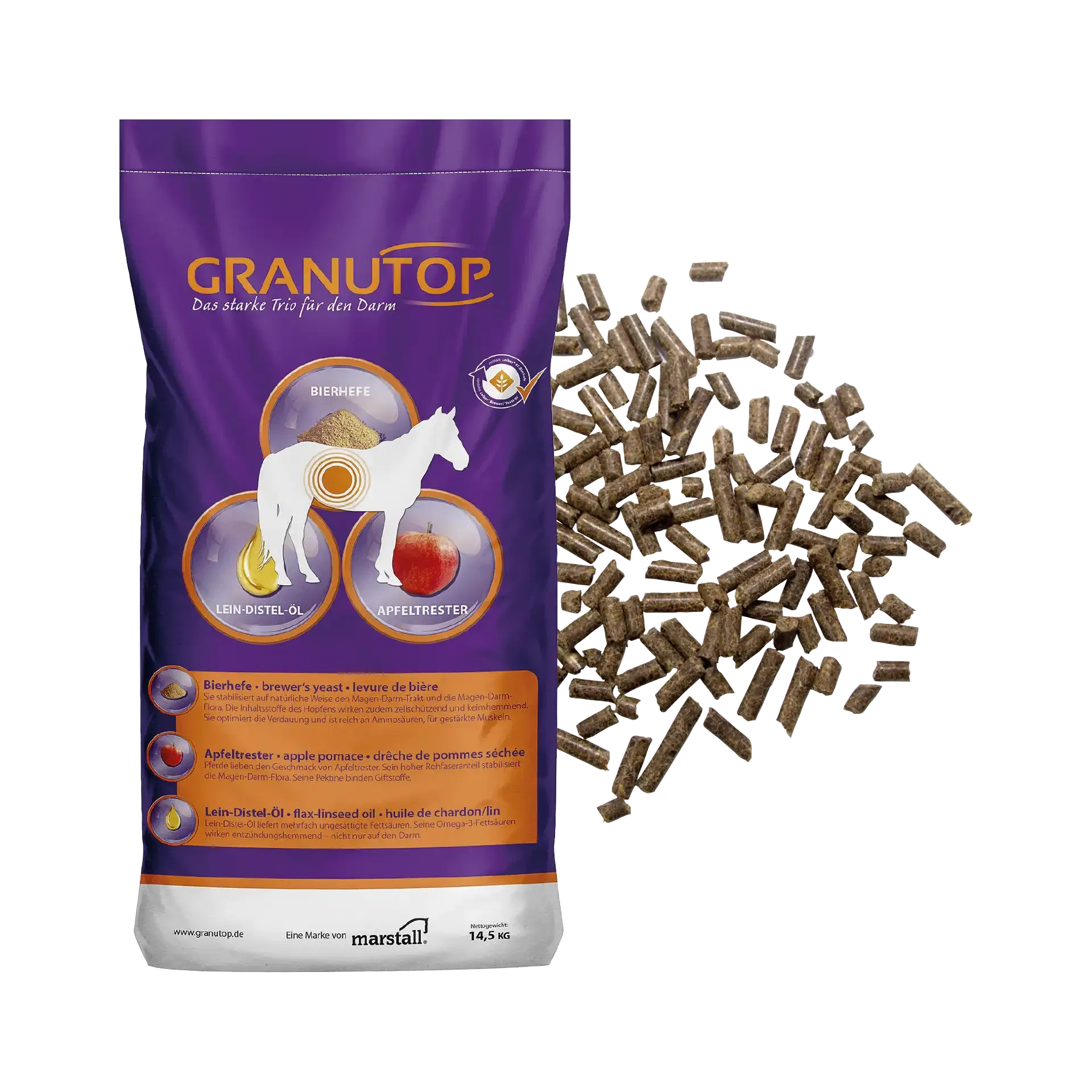
It’s not quite that simple: it depends on what kind of muesli you’re feeding. That’s because your horse’s body doesn’t just need a bit more energy, but specific nutrients. As an example: hair largely consists of keratin, which is rich in sulphur-containing amino acids (methionine/cysteine). When so much hair is shed at the same time, large amounts of methionine/cysteine are lost and the body has to replace them. Since they are essential, they must be supplied through feeding. Small intestine digestible methionine is found in grass, soy extraction meal, soya flakes, rapeseed extraction meal, and above all in brewer’s yeast products such as marstall Granutop. There is also the option of feeding the pure amino acid (DL-methionine), as with marstall Haut-Vital, for example. In addition to sulphur-containing amino acids, this muesli also contains the organic sulphur compound MSM, as well as all necessary vitamins and trace elements in a high-quality, organic form. With this muesli, or with the grain-free amino-mineral feed marstall MineralOrganic+, an extra portion during coat change is sensible and genuinely covers requirements.
Myth 6: Extra mineral feed is enough during the coat change
Most mineral feeds contain vitamins, trace elements and macro elements. This makes sense, as zinc, copper and selenium, vitamin A, E and also biotin are very important for the coat change. However, the body is still missing the main building blocks for the keratin in the hair: the sulphur-containing amino acids. The body does build some of these from its own protein. We recommend supplementing these essential amino acids to ensure the growth of the new coat. Alongside a good mineral feed such as marstall Force, marstall Granutop should also be fed to supply essential amino acids and omega-3 fatty acids. Alternatively, there is our special mineral feed that already contains amino acids: marstall MineralOrganic+. We can also recommend muesli varieties such as marstall Haut Vital, MyoCare or BodyForm. As well as the feed supplement Amino-Muskel or marstall Huf-Regulator, both of which provide essential and available amino acids.
Myth 7: Hay and herbs are sufficient during the coat change
The better the blood supply to the hair papilla, the better the formation of the new hair. Herbs that support blood circulation, along with trace elements and minerals from herbs, therefore certainly have their place. However, the right nutrients are also needed in the blood! Standard horse hay usually provides the horse with too little small intestine digestible essential and, in particular, too little sulphur-containing amino acids. Yet these are precisely the important building blocks of hair keratin. Important omega-3 fatty acids are also found in grass seeds, which are often present in insufficient amounts in hay. Our stable family recommends supplementing with high-quality muesli during the hair growth period, such as marstall Haut-Vital or BodyForm, which not only contain both sulphur-containing amino acids but also vitamins and trace elements.
By the way: if you would like to support your horse’s skin blood circulation, we recommend marstall Huf-Regulator, which also ensures an adequate supply of amino acids.
Myth 8: Unsaturated fatty acids give a shiny coat
Hairs are coated with sebum from the sebaceous glands and shine more when plant oils are added to the ration. In fact, unsaturated omega-3 fatty acids can do much more than that: they accumulate in the sebum, which also covers the horse’s epidermis with a fine film. They also keep the skin supple and support its regeneration. In addition, the protective film forms an effective barrier against germs and toxins. High-quality plant oils such as marstall Lein-Distel-Öl should therefore be fed at least during the hair growth phase, but preferably beyond it as well.
Myth 9: Rugging up reduces the strain
Rugging up or the ambient temperature only has a minor influence on the moulting process; the speed or extent of moulting can be dampened. However, moulting is actually controlled by day length. The daily amount of light influences the hormones and thereby triggers moulting. Rugging up is very sensible during cold snaps in spring, once the warming winter coat has already been shed. Naturally, senior horses or sick horses should also be supported with rugs where needed
Myth 10: The winter coat won’t shed. Could this be a nutrient deficiency?
In younger horses, a delayed coat change can be caused by nutrient deficiencies. If your horse is affected, the ration should be checked, in particular with regard to sulphur-containing amino acids, trace elements and vitamins.
In older horses, however, Cushing’s – more precisely known as PPID or ECS – is often the underlying cause. A failure to shed the coat, along with a long, curly coat, are key symptoms of the disease. In addition to medical treatment, feeding must be grain-free. Here we can support your horse, for example with marstall Faser-Light, Senior Aktiv, Vito or Haut-Vital.